Showing posts with label Theatre. Show all posts

Monday, 8 June 2015

The Krampus Virus

01001011

 We didn’t have to put on a show. We could’ve done this under the radar, but we didn’t. We did this for you. We wanted you to know that you had the power. The ability, to make your own decisions. We wanted you to do more then just throw things at them. That’s childish and petty. We wanted to give you the chance to do something amazing. Just remember, this one’s for you.

01110010

 Before us is a large decadent apartment living room, in the centre of which is a queen-sized bed with purple satin sheets. The walls are a neutral gray and dotted with various expensive looking pictures. The fourth wall, through which the audience can peek into the unfolding scene, is invisible and indicated by the wall-line on the floor. There are two light sources. A dim yellow one, emanating from the bedside lamp. The second comes from an active laptop. This white/blue light bleeds in from the right hand side of the apartment. In the very background there are two large windows that are draped with red curtains. Upon the bed sit two people. They are bound and gagged and do not speak, but they have a look of pleading panic in their eyes. Three more people occupy the apartment. One, NICHOLAS, paces the room, periodically peering out of the window at something behind the stage. CHARLIE sits by the second source of light and spends most of his time interacting with the computer. RILEY, desperately trying to hide a twitch in his left leg, holds the gun, aimed at the two bound hostages. At certain intervals a third light source appears, this time pouring in through the curtained windows, whenever NICHOLAS decides to peak at something off stage. CHARLIE, NICHOLAS and RILEY are all wearing devil costumes, reminiscent of the folkloric creature Krampus.

CHARLIE [excited]: Alright, we’re just about to hit twenty thousand people. Can you believe that? TWENTY! We’re doing some serious damage here.
NICHOLAS [turning to CHARLIE]: What about the code? It's not overriding itself is it?
CHARLIE: Nah, we're good. It’s cracked most of the bank accounts. Over twenty thousand people are getting an early Christmas present.
RILEY [in a hoarse, dead voice]: Ho Ho Ho.
NICHOLAS [looking worriedly at CHARLIE, turns and put a hand on RILEY’S shoulder]: You okay man?
RILEY [brushing NICHOLAS off]: Yeah, I’m good man. I’m chill.
VOICE FROM BEHIND THE CURTAINED WINDOWS [person is using a megaphone]: Alright! You’ve made your point. There’s no need for the hostages to get hurt. Talk to us, and we can figure something out.
NICHOLAS [to the room]: Woah! It looks like every cop in town is out there. [to CHARLIE] How long do you think before the negotiator gets here? I wanna agree upon a trial date. No jury of our peers is gonna find us guilty. Especially after what we did for them.
CHARLIE: Haven't got a clue. Hopefully soon. Sounds rowdy out there. Hope the cops don't take matters into their own hands. [more excited] Jeez, this viewer count is going up like crazy. [turning to NICHOLAS] Wanna say something?

01100001

Even though she really needed to go to the bathroom, she just couldn’t leave her seat. She felt that if she moved, even just for a moment, she would miss something really important. Another devil addressed the audience now. It seemed as though his speech was just for her. She could hear a poor attempt at whispering behind her and quickly turned and shushed them. The devil spoke of rebelling, of taking back the power they had lost. His words made her feel as though she was part of something big. She had pressed the .exe after watching the show for about five minutes. There was something about these people that made her trust them. She hadn't had time to check her account, but she had a feeling she knew what to expect. Looking around her dingy apartment, she was happy that for once, she could have a proper Christmas. No more taking money from her Mom. No more 14 hour shifts. This show was going to change her life. And then the cops burst in and the video feed went dead.

01101101

 Before us is the inside of a police van. The steel walls exhuberate a sense of dominance and the enclosed area gives off a feeling of claustrophobia. The doors are invisible and indicated by the wall-line on the floor. CHARLIE and NICHOLAS sit in chains with their masks off. Two guards sit opposite them, faceless, due to their visored helmets. RILEY has exited stage left.
CHARLIE [in between sobs]: Why didn’t he let go? Why? Why? Why? [at the guards] He wasn’t going to do anything!
NICHOLAS [trying to comfort CHARLIE]: Come on man. We all knew the risks. Come on lover, don’t cry.
CHARLIE [inconsolable]: That...doesn't change the f...fact. He..he would never…
NICHOLAS: Please, just...We knew what was going to happen. We were both afraid that Riley would…
CHARLIE [yelling at NICHOLAS]: Now!? You bring that up now?! You know what…
GUARD: Quiet!

01110000

There was something about the ending, that made the whole thing sour. It felt like it wasn’t the ending that it was building up to. It all felt wrong. She did end up getting what she needed. Everyone did. All the people who executed the Krampus virus got what they were promised. But even though the virus had hit most of the major banks, once the wealth was spread around and most business’ adjusted the prices of their products, not much had changed. The show promised her a utopia, a fairytale land. Instead, once it was over, she returned to reality.  

01110101

 Before us is the interior of a prison cell. The walls are drab and inspire dark thoughts, more than those of rehabilitation. The cell door is indicated by the wall-line, which is transparent. Any action that occurs on the foreground, in front of the cell-line is the characters inner monologue. CHARLIE sits in the cell alone. NICHOLAS has exited stage left.
[CHARLIE silently sits in his cell for a few moments before standing up and crossing the cell-line into the foreground]
CHARLIE: We wanted to help. Nicholas said that if we turned it into a show, then more people would be interested. Both Riley and I agreed. We wanted people to stand up for themselves. I just wanted to help., but then they both started to talk about taking hostages...and guns. The guns weren’t even real. I hate guns. But Nicholas...he had a way with words. Riley was gun-ho, from the start. He couldn’t wait to make a scene, show off to everybody that he had what it took. He was a wreck when we all got there. I still thank god that the guns were fakes. Those first few minutes were terrifying. I thought that we would have to subdue him. We would’ve never managed to send the virus to so many people, but he got under control. Nicholas helped him ease up, and I believed the lie. I thought everything was going to be okay, and now they say that the codes have been expunged from most of the systems. That it was all for nothing. When Nicholas got the news. I thought someone had punched him. However, in the end, he didn’t care anymore. We had dedicated years to this idea. And it was all gone. We were streaming it out live. We tricked ourselves into thinking it was a movie. People don’t die in movies. They come back at the last second for dramatic effects. All those people we streamed it out to. Most of them are here with me, waiting on a verdict. But mine is in. Oh, Nicholas...I’m so sorry. I loved you, so much. But I couldn’t help you when you needed me most. That’s what still bothers me. That’s why I can’t sleep. I can hear them coming. The curtains are closing.
[Two GUARDS come inside and bring CHARLIE up to his feet. He complies and follows them and exits stage left]
CURTAIN

1110011

In what seems to be a modern day spin on the Robin Hood legend, a gang of three hackers; consisting of Nicholas Haines (32), Charlie Skinner (28) and Riley Beckett (37), now commonly known as the Krampus trio, attempted to unleash a virus to the masses which would hack into the the central bank accounts and transfer funds from the rich to the poor. In an attempt to bring their cause to the publics attention, the gang took billionaire Robert Wayne (55) and his wife Stacy Wayne-Kyle (54) hostage. They had even set-up webcams and were at one point streaming to more than twenty-five thousand viewers. Over thirty-five thousand activated the virus. Due to the hard work of the FBI, the virus led the authorities to over half the locations where the program was used. Most are now in police custody awaiting trial, in their respective countries. The original trio of hackers are now all dead, the last surviving one received the death penalty two days ago. With the market returning to normal and banks now, more than ever, focusing on electronic protection, economists predict that the year to follow will be business as usual and not to expect any further shake-ups like the one we have seen this past month.

00001101


Andrew J. Buring

Tuesday, 15 April 2014

Eden on Stage

It was a long time since I opened Jack London’s novel Martin Eden – and in my hazy memory, I only had a rough idea about its plot and themes. All the more surprised was I to discover that there is a theatre adaptation of it at Divadlo bez Hranic. Simple curiosity and also growing desire to go to the theatre again pushed me into buying a ticket – so after a busy school day, I and two friends grabbed our seats at the small Prague theatre.

To be honest, all I knew about the theatre adaptation was that it is essentially one long monologue, accompanied by music. When this turned out to be true, I was afraid; would my company (who haven’t read the novel) find the evening as delightful as I was? I at least knew what was going on – but the story is a little lengthy and repetitive! Soon I realized that these insecurities were unnecessary, as everyone – even the high school class of teenagers at the back who were obviously there because they had to be – were absorbed by the performance which turned out to be metatextual.
Image credit: Divadlo Bez Hranic
How so? The performance opens with the entrance of a stranger to a bar; he and the owner decide to spend their lonely night by telling the tale of Martin Eden. The stranger plays the character of a self-taught working-class young man who desires to become a writer in early 20th century America and the bar owner turns into a pianist, who occasionally says the lines of characters like Ruth (Martin’s beloved bourgeois lady) or editors from various magazines Eden sent his stories to. Together they vivified London’s famous novel, jumping from serious moments of despair and confusion to heart-warming ones of love and success. It was all the more smile-breaking at the end of the two hours though to see the protagonist (now a popular writer) so emotionally ruined that he commits suicide by drowning into the sea.

I entered the theatre without any expectations – only small worries – and I left with a contented soul that desired to open the novel as soon as arriving home and read deep into the night. In short, I believe the theatre adaptation is a good reminder of the novel or at least a wonderful trailer to it for those who haven’t read before the challenging road to success of a courageous sailor... And it is definitely worth reading London’s novel even though neither the author nor his work is on our BA American literature reading list. 


Anna Hupcejová

Friday, 14 February 2014

Lolitas on the Road called Life

Rock Café, almost 8pm and there was a line that extended all the way to the entrance door. This queue consisted of people wearing punk outfits; fishnet stockings, heavy dark eye-shadow and some were even rocking out the mohawk. “No way that these people are going to see the play!” I thought. at that moment I decided to cut the line and ask the guy at the ticket stall about that. “No, it’s for the punk concert happening downstairs. You’re going for the play, Right?” It felt victorious to hold the entrance ticket, so did sitting down next to a few other Anglophone Studies people in the theatre room who also came to see our fellow student Magdaléna Hniličková perform.

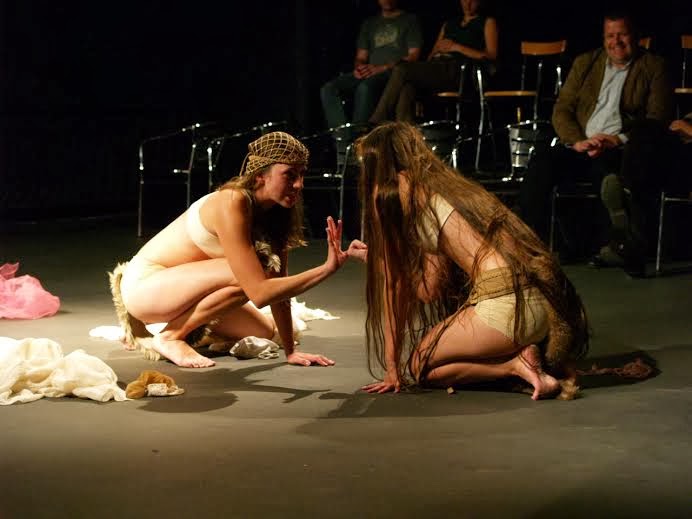
I was told beforehand that the play will be 1) short, 2) performed mainly in underwear and yet 3), not at all erotic in the Nabokov novel sense. Even with these warnings, I did not expect the performance to have such psychological depth. Through story-telling, masks and role plays, the two young female characters opened up to the audience. There were frequent shifts of emotion; at one moment, the audience was laughing almost hysterically at their wolf dance or sexy-lass dressing-up, but just as quickly silence filled the room as a story implying rape was told. This dynamism of both verbal and physical form in combination with light effects and occasional usage of drumbeat and xylophone music kept all senses alert and one did not feel the urge (or even thought) to look at the time.

Once the play was over and the room was in a few-second of darkness, I was in a short mental pause. As the lights went up again and applause filled the room, I came to the realization that “Lolitas on the Road” discusses matters that are more relevant and understandable to women than to men. This was due to lines such as “Why should you get dressed up for him? You should do so for yourself!” or “Life with men is hard – but without them, it’s even harder, you have no choice.” Nonetheless, I believe that both genders can benefit from seeing this performance that will take your mind off matters like exams, credits or post-Christmas weight gain, if only for 45-50 minutes.

-          Anna Hupcejová


(Image credits: Vojtěch Morava)

“Lolitas” in a paragraph

The two "Lolitas" seem to be having a tough time deciding what to wear - but there are two lost and scared souls crouching underneath the layers of innocent white cloth or provocative tulle. A thought-provoking play shows the transition from innocent playfulness to a new identity which may as yet appear unclear and disturbing. What is the play about, then? About doubts and fears, hidden behind girlish giggling? About looking for your new identity and being surprised at what you find? About being supposed to grown up and not having a clue how such things are done? You’d better see and decide for yourself. This short play may well provide you with enough food for thought for a week.


-          Denisa Šebestová

Henry V and Coriolanus: A Day with Shakespeare on the London Stage

London is a dream come true for theatre lovers. From contemporary and experimental drama, through musicals, to the classics, there is a performance for everyone, and often with a stellar actor in the lead role. As one wanders around the West End and Covent Garden, names like Ben Whishaw, David Tennant, Matthew Macfadyen, Jude Law, or Tom Hiddleston glisten on the posters decorating the fronts of the theatres. The last two gentlemen star in productions of Shakespeare's plays Henry V and Coriolanus respectively – both critically acclaimed and sold-out performances, or perhaps not quite sold-out. Sometimes getting up well before dawn and queuing for hours in the hope of snatching one of the few returned or standing tickets is just what it takes to get in, and I did. The 4:30 a. m. start was well worth the effort for having the pleasure of witnessing Jude Law lead the English to the battle of Agincourt in the afternoon, and Tom Hiddleston almost singlehandedly defeat the town of Corioles in the evening.

Henry V is one of Shakespeare's finest history plays, portraying the king of England making his claim on France. Directed by Michael Grandage at the Noel Coward Theatre, this play about leadership, warfare and patriotism – themes that resonate with the audiences to this day – is brought to life in an exciting production. A whitewashed wooden half-circle serves as a set, clearly referencing the “wooden O” of The Globe the Chorus mentions in his opening speech. Its simplicity leaves much to the imagination of the audience, while providing a space for mood-enhancing projections and allowing ingenious use of the various doors and trapdoors to portray the changing locations amid the chaos of battle. The actors appear in medieval costumes, except for the Chorus whom Grandage also assigns the role of the Boy. He is clad in contemporary clothing, wearing a Union Jack T-shirt and jeans, thus establishing perhaps a little too forcefully a link with the present. His double role, performed by the energetic Ashley Zhangazha, often highlights the contradictions of the grand patriotic speeches of the Chorus and the bloody reality of war.


Image credits: Magdalena Císlerová
Whether or not Henry's war (or any other for that matter) is just is one of the principal concerns of the play, and one that is not resolved easily. Jude Law gives a wonderfully complex portrayal of the warrior king, unafraid to highlight Henry's moments of introspection, fear, or anger alongside his authoritative royal conduct. He excels at the rousing “Once more unto the breech” and the St Crispin's Day speeches, while not shying away from Henry's darker moments, which he performs with chilling intensity, such as the threatening speech to the people of Harfleur or ordering to kill all prisoners. His wooing of Jessie Buckley's French Princess Katherine is just the cherry on top of a great performance. This marvellous scene, so often cut considerably in many performances, is incredibly witty, humorous and romantic at the same time, and Law plays it with exactly the right amount of cockiness, playfulness and affection, winning not just the sympathies of the princess in question, but of the whole theatre.

Incidentally, Tom Hiddleston stars as Henry V in The Hollow Crown series, the recent BBC's superb adaptation of four Shakespeare's history plays: Richard II, Henry IV Part 1, Henry IV Part 2, and Henry V. However, he takes on quite a different role – that of a proud Roman general who goes from hero to zero – in Josie Rourke's production of Coriolanus. Set in the early days of the Roman republic threatened by the Volscian army, Coriolanus almost singlehandedly wins the battle and returns to Rome, celebrated, to run for consul. Yet he is unwilling to overcome his pride to suck up to the plebeians, and is expelled from Rome. He joins the Volscians in order to take revenge on his own city. A play full of angry crowds and bloody battle, the tiny 250-seat Donmar Warehouse makes for an interesting choice of venue, however the play works surprisingly well in such an intimate space, which Rourke utilizes ingeniously. The staging is reduced to a brick wall sprayed with graffiti by the plebeians demanding “Grain at our own price”, complemented only a by a single ladder and a row of chairs, which together with a few fireballs are enough to convey brilliantly the battle scenes at Corioli. Graffiti is added throughout the performance, chairs are manoeuvred around as loud techno music fills the theatre, while the actors stroll around the stage in an eclectic mix of contemporary and Roman clothing, the soldiers sporting skinny jeans and Doc Martens with leather armour, gloves and swords. The refusal to confine the production to a certain period of time emphasizes the relevance of many of its issues, such as the struggle for democracy, power of manipulation, and the responsibilities of public service, to today's audiences.

The fights are ferocious, so much so that in one scene Coriolanus emerges from behind the battlements so drenched in blood he later takes a shower on stage, gasping as the water hits his wounds. It is quite an extraordinary moment, providing not only eye-candy for the female audiences, but more importantly showing the vulnerability of the flawed hero, turned into a killing machine by his monster of a mother who rejoices at each of his new scars. Hiddleston gives a breathtaking intricate performance as the Roman soldier: fierce in battle, humble after victory, scornful in his treatment of the plebeians, gentle with his wife, and thunderous upon his expulsion from Rome. When his mother, wife and son plead him to spare Rome, Hiddleston's long unmoving gaze reveals with much intensity his dilemma and emotional turmoil as he decides to exchange pride – his vice – for sympathy, knowing he is signing his death warrant by doing so. The rest of the cast deliver superb performances as well, especially Deborah Findlay as Coriolanus' overpowering mother Volumnia, and Mark Gatiss as the witty senator Menenius.

Neither Henry V nor Coriolanus are among the most popular plays of the Bard on the Czech theatre scene, but on the stages of the Noel Coward Theatre and the Donmar Warehouse they come to life with such a thrilling force in well-crafted and illuminating productions that it is clear they have much to offer. As I was leaving the Donmar Warehouse that night, the poignant image of Coriolanus' execution still fresh in my mind, I knew that the fate of the warrior king and the Roman general would stay with me to ponder long after the tube ride to my temporary London home was over.


-          Magdalena Císlerová

Monday, 23 December 2013

Tempting Shakespeare

The theatre ensemble of current and former students gathered to present one of Shakespeare´s dramas, The Tempest. Charles University Workshop Production led by John Martlew managed to rehearse the play within only one month so that people could see it before Christmas. There were four performances of The Tempest: 24th, 26th, 27th November and 3rd December, they all were staged at the theatre Na Prádle in Malá Strana.

The actors-amateurs should be praised not only for the fact that they had such a short time to practice and that the play is very long, but also because they turned out to be some truly talented young people. There is no doubt that it has to be difficult to pretend to be constantly drunk during the play or to jump up and down like a monkey all the time or even to look decades older that one actually is. The set was laid out in a strictly Elizabethan way using very little props, which helped to draw the spectator’s attention to the beauty of innocent Miranda and talented bare-chested Ferdinand.

The keen spectators could study a short glossary which they received together with the programme as a freebie. The even keener ones, who read the programme till the very end, might have wondered about the special thanks dedicated to the Czech-Japanese Association. As the play proceeded a little bit, the strange yet humorous choice of an Asian wardrobe was striking. The absurdity of that was supported by the Italian names Shakespeare gave to the characters. In order to make the play unusual, John Martlew took some of his imagination from the time he has spent in Japan and used it here. Apparently, the costume designers have chosen the kimonos quite well as they worked well with the performance of the gifted students which surpassed the expectations of many spectators.

-          Magdalena Schlindenbuchová

Questions for John Martlew

When leaving the theatre after seeing “The Tempest”, I thought how marvellous it would be to interview the man behind the production. I was lucky to find myself at the Plato restaurant, conversing with John Martlew only days after arranging the interview through the phone, not by email. Though I had a line of questions prepared, it developed spontaneously in an hour-long conversation.

Miscellaneous

Firstly, what is your connection to Charles University?
I taught here from 1992-1999 and that is when I started doing the plays. I think it was in 1997 I just decided I’d like to do a drama workshop. Eventually students from the Philosophy and Law faculties were brought in and the general philosophy is that the actors must be students and non-native speakers. The purpose was to get students to do Shakespeare also outside the classroom... and yes, that’s how it all started. I always come in Autumn for a Thanksgiving party and then got 5-6 weeks to produce it and I come in again during Easter, so we produce about 2 plays per year.

When did your relationship with Shakespeare start?
At university, where I directed “Measure for Measure”. I always had a passion for Shakespeare. I studied English literature and Greek and Latin. English universities are different than here, because there are so many societies that also have funding. I always preferred directing than acting.

Did you ever act?
Yes, of course. For example I played Ferdinand once. But I still prefer to direct than to perform.

Why so?
I always make a distinction between actors and performers. A performer is always himself during acting while the actor loses himself. Lisa Minnelli, for example, is a performer – she’s always herself, doing something. I always find it hard to lose myself – so that’s one reason. Also I suppose directing is like conducting, the way one puts everything together. It is always a matter of interaction with the people, seeing what you can get out of them and this is what interests me.. However, I don’t meticulously plan a production before I starts; “The Tempest” was one of those.

About “The Tempest“

Do you like the play itself?
I am not actually that fond of “The Tempest”. I prefer “Measure for Measure”, it was very rewarding and so was “Twelfth Night”.

Why are you not fond of “The Tempest”?
Because to me, the characters are shallow, they are impersonal! Prospero is vicious, yet he is still a victim. What I can’t see in the play is a general theme, a moral – it moves towards forgiveness, but you don’t feel it to be the main idea. Neither is Revenge strong enough to be the main theme. There are hundreds of interpretations that see Prospero as God, but you cannot push any of these theories forward. There was even a production that saw him as a myth of colonisation, a superior spirit, but you can’t work out a consistent idea. This happens often in other Shakesperian plays and characters – even the villains suddenly have moments when they have another side! Caliban in a single moment turns from a negative character to gaining sympathy and being believable. The human condition is superior.. That is what makes it interesting, there are always 1, 2 lines that change everything. Romeo says: “O, she doth teach the torches to burn bright” and after that he is completely lost and eventually dies.  

Where did you rehearse?
In my flat! There is a big room and during the weekends we rehearsed at the Faculty. During the week it is virtually impossible to find a free room.

Which was the most difficult part of producing “The Tempest”?
The lighting, timing for rehearsals, sound... And moving it from my flat where we rehearsed into the theatre.

There were evident influences of Japanese theatre in “The Tempest”. Why so?
I worked in Japan for first 2, then 3 years - I taught at a university there.

About Prospero, I noticed that while in the original text he is portrayed to carry his staff around the stage, in the play he throws it away at the very beginning!
Yes, the props get onto the stage, but also must go off the stage! Generally the audience notices the big things, not the small things.

Have you seen any theatre adaptations of it before?
No, I have only seen one production. I don’t see theatre much, for I am abroad a lot. In England you have to be near London to see productions and I’m not. And I’m quite fussy I suppose – if I’m not happy with the production, I leave during the interval.

Do you consider yourself to be critical?
Where Shakespeare is concerned, yes.

Are you self-critical?
I have to be. Sometimes the actors cannot do what you want them to do and you have to accept that – but I try to bring out of them what I want.

Did that happen during “The Tempest”?
No, actually. That was the first time that did not happen. Mikuláš Mařík, for example, who played Caliban, whenever I was to tell him what I want from him, he was already doing it. It is quite noticeable that the “old” people have a consistency of performance. From experience, I know that if the body is somehow connected to the text, you know they can act.

Like a connection?
Yes, a connection. You can read the text beautifully, but if the body is not somehow involved, the performance is generally not so good.

Was there someone who surprised you at “The Tempest”?
Stefano (played by Milan Růžička, ed. note) was a massive surprise. Playing drunk is very difficult; you over-play, waving your arms, stumbling... But I did not expect that kind of performance to come out of him! He read very well at the casting, but the quality of his performance amazed me. You can never tell this, how very good they are going to be, all you know is that it won’t be dreadful.

Are you content with “The Tempest”?
Yes, especially having the shortage of time in mind. Generally it was the way I wanted it to be, I suppose it was okay.

“Okay”?
[Laughs] I don’t see it, it was just okay. I try not to interfere during the plays, like during the pause walk up and say “It’s so very slow today, liven it up a bit”. And sometimes it happens that the audience is not responding as you expect... I have given negative feedback once or twice when the people did not take it seriously, but otherwise I am amazed at how well the actors generally are, especially in this production.

On the Charles University Workshop Production and its future

Do you consider there to be a difference between English and Czech students?
Czech students still read books! But then, I never taught English students. I can say however that I find my experience here very enriching; the interest, the way they enlighten me with their knowledge, enlighten me with their youth. I am an old man, you see and I am amazed when they treat me like one of them.

Do you have a favourite production?
The ones that become favourites are the ones that do what you wanted them to do. The “Twelfth Night” did exactly that. The “Merry Wives of Windsor” was very successful with the audience though it wasn’t my favourite. I was pleased with “Measure for Measure” and especially pleased with “The Winter’s Tale”. The people in it wanted to be in it and also because of this it had a level and so I consider it to be the best.

What play are you planning on producing next?
No idea really. But when choosing a play, I keep three things in mind. Firstly, I have to like the play myself. Then, I have to have the cast, the people to do it. I have to be able to imagine them in the play. And thirdly, the play has to be accessible to the audience – it should not be full of words.

How does the casting work?
I do it personally. We do have a website, but I prefer to keep it within the university. We perhaps miss people, good actors, but we have to restrict ourselves. It happened though that I have lost contacts to two great actors who I have never found since... It is basically a matter of personal connection. I usually go speak to the first years, mainly in the Translatology department, especially because the head is very supportive of the project.

What about the Anglophone department?
We get a few people from there as well – a few, because again, there are very little men. Shy or not interested... Many good actors are shy, not the show-off types. Interestingly, there have been great actors from the Translatology department. However, we never had anyone from the Faculty of Education! The main problem is finding men, male actors in the English department; there are many women. We always had more men interested in acting women, maybe because women know that there are 4 female parts in Shakespeare? But no, I always try to recruit actors from especially the first years.

Isn’t it easier to work with male actors?
No, I don’t find it so! Men can be equally hot-blooded, as well as more sensitive. I don’t find a difference really, but there are more men coming to audition. Perhaps the girls are more shy... In England, I think, there would be more women interested in acting than men, but that is just my personal speculation.

It’s been 20 years since the first production of the Charles University Workshop. Given Prospero’s final line, ‘farewell to the stage’, does it in your view have a connection to the Workshop’s continuance?
I did not think of that. But I do hope that the production will go forward. If I stopped, I think I would be the one who could carry it on, for he has the support of the faculty. One does not know! But the main thing is trying to get new people in it, for doing it is what is important. So okay, one wants the production to be as good as it can, but the actors and audience are important factors, together with the ones I have listed before.

Final questions on Shakespeare and drama

Do you produce also plays other than Shakespeare’s? If not, whose and what work would you choose?
The main reason why we do Shakespeare is because of the connection to the Faculty. I did co-produce Wilde’s Importance of Being Earnest, but that was just an attempt to get people to produce something themselves. If I were here all the time I would do some modern plays.

Have you read any Czech drama?
Some, like Čapek, but a long time ago. There is really no point in doing a Czech play in English in Prague, same goes with doing a Greek play in English in Prague.

In the Literature on the British Isles seminar we studied “Merchant of Venice”. Any chance of you producing that?
No – for we haven’t got a Shylock! There was this one man who was in “Measure for Measure” and another play, but left soon. He might have been the role, but I don’t see anyone at the moment. Plus, it is a difficult play to stage, with the caskets, the frequent change of setting...

If you could ask Shakespeare a question, what would it be?
“Where did you come from? How did you manage to do it? How did it happen?” He has this incredible insight.

- Prepared by Anna Hupcejová

Sunday, 10 November 2013

What is there to lose? A Review of Molly Sweeney

It was the first weekend of the new academic year and I went to see Molly Sweeney at Divadlo Rokoko. I was slightly worried that the theme of the play (different forms of blindness, failed hopes) would be too ‘heavy’ for a Saturday evening; in the end however I was pleasantly surprised by the Czech theatre adaptation of Brian Friel’s work.

Unique in its use of solely three characters that indirectly communicate with each other through monologues, Molly Sweeney simply could not leave one unaffected and bored. The actors’ (Dana Batulková, Vasil Fridrich, Aleš Procházka) performances were captivating and so were the monologues. The audience travels through time, places and the emotional states of the characters that are all connected by their failed attempt to restore blind Molly’s ability to see. In two hours which passed very quickly, I experienced a roller-coaster of emotions; hope, joy and despair, to name just a few. The differing aspirations of the characters made it increasingly obvious that the plot was not going to end well. In short, it was a theatrical study of how a project goes wrong and the life of those involved changes - though not for the better, hence getting me into a rather disturbed and sad state of mind. Nonetheless, I was not depressed; instead, after a long time, I was grateful for even the smallest things in my life that are successful and I received a greater desire to live –hence making Molly Sweeney similar to Chekhov’s plays in terms of effect.

Days later, I was amazed by how the visual and auditory memory from the theatre vivified the reading of the play – which undoubtedly will be an advantage when writing an essay on Molly Sweeney in the future. As for the Rokoko adaptation, I highly recommend seeing it   you might see things clearer or even differently after you leave the theatre.

Next term of performances: 27.11. – it is 110Kč with your ISIC and chances are, most of the seats in the audience will still be empty and you might end up in the front rows, just like I did!

- Anna Hupcejová

Monday, 5 August 2013

Review: The National Theatre Live

On the 13th of June, two Prague cinemas - Světozor and Aero - allowed to experience the live broadcast of a show that was performed on the stage of The National Theatre in London. 

The Audience is the new play of Peter Morgan; it is playfully and wittily written and was brilliantly performed. Helen Mirren starred in the main role and we, young actresses, could only sigh and say to ourselves: Will I ever be able to perform like that? The director Stephen Daldry skillfully worked with tempo-rhythm and although the play may  have seemed too conversational and not much dynamical, the audience was held in permanent attention from the beginning to the very end. During the broadcast, both English and Czech subtitles were provided. 

The project of live broadcasting was launched in June 2009 and the shows can be experienced in more then 500 places around the world. The next one is going to be of Shakespeare’s Othello on the 26th of September, so do not hesitate and go see it! Yes, this is a shameless propaganda, but the project is really worth it.

- Magdaléna Hniličková

Note: More information about The Audience on: www.aerofilms.cz/filmy/142-National-Theatre-Live/synopse/.