Showing posts with label issue number seven. Show all posts

Friday, 14 February 2014

Overture to the Janaury/February double-issue

Since December was a busy time with Christmas, New Year, last lessons and first anxiety attacks from the upcoming exam period – so understandably no MP was published in that month. To catch up with the months, what you are reading now is the overture to the January and February double-issue.

One often hears the words “quality, not quantity”. Even though this MP is longer, I decided to put in new themes and people outside of our university. So alongside the usual sections with poems and event reviews, you can look forward to reading interviews with our professor Justin Quinn, the Prague-based British musician Alasdair Bouch and American writer Hans Fellmann. Furthermore, there are articles on Prague, written by three ERASMUS or exchange students who I met during the search for a native-speaker editor back in October. It was interesting to notice that though discussing the same theme, they each focused on something else, like the education system, food or Czech history.

I hope you will find this issue as enriching a read as I did when putting it together.

Download the beautiful PDF version of the MP here.

-          Anna Hupcejová (Editor in Chief)

The Message

I
Jerome looked out the window. It was one hideous afternoon. He closed the shutters and gazed about the room. A fit of nausea disturbed his stomach. After some contemplation on the meaninglessness of the improbable, he checked his FB (for which he loathed himself) and on seeing one new message and two notifications, his heart throbbed. Both the notifications were some stupid invitations—now the message. He first checked his mail to prolong the suspense of pleasure.
“Might it be Catherine?” he thought to himself. She hasn’t replied in over two days. He was sure she was too busy.
“Yeah, busy,” he uttered mocking his self-delusion and as he opened the message realising it’s his annoying mate sending him some disgusting video again, his frustrated heart got pierced with an aching pang. Claustrophobic as he was, he knew he had to get out of that situation.
“But the date had gone so well, so what went wrong? Why isn’t she answering…” he asked a dumb looking computer screen which could use some cleaning.
The sweet heavenly ring resounded through the room. A new message! It wasn’t on FB though but on his phone. He eagerly opened the message. It was her!
“Hey I’m sorry i haven’t answered sooner, I was super busy with school and stuff,” she wrote but hasn’t continued in answering his initial question. A minute passed, two, three.
“I did ask her a question. She has something to react against, come on,” Jerome assured himself. Still, after five minutes of silence, he broke.
She replied, after 6 minutes, “yes, I had a great time as well. Well, not in the near future. I’m not sure, I have to check.”
Jerome thought to himself, “damn, damn, I wasn’t supposed to come outright asking for the next date. First some small talk, survey the grounds, act casual…”
Ten excruciating minutes passed. Jerome was trying to forcefully cool his head but to no avail: “Should I end it if she tells me she doesn’t have time? Though she did say she had a good, no, GREAT time. Yeah, everything’s ok,” repeated Jerome to himself as a prayer. A message beeped:
“What about next week, Wednesday?” she suggested. Jerome knew he already had something.
“No good, Thurs?” he replied.
After three hours came this:
“Weds would be really good… Thurs no go, what about Fri at about noon?”
He had to take it, despite the unromantic daylight. He’ll just have to charm her.
“Deal, so at 2 in front of the bookshop where we met?”
“Deal” read her reply.
“Should I write that I’m looking forward…” thought Jerome. He sent it and regretted it the minute the ‘swoosh’ sound of a sent message escaped the little phone’s speakers. She hasn’t replied.

II
The day came and Jerome was darting nervously from one over-priced café to another touristy damp, awaiting his date. She was 15 minutes late but upon her arrival started apologising excessively. She looked gorgeous, better than he remembered. He hoped she thought the same. They sat down in a nice café. He was able to commence with a vigorous conversation and even a few jokes. Once he saw the immediate response and her amused attention, he felt confident and the afternoon started to unfold with great expectations.
He did the swift ‘interrogation’ game with questions like “Cats or dogs?” She was into it.
“Cats; wine for Christ’s sake; the beach and only the beach, my father… wait what?!” She was taken aback by her answering so quickly.
“It’s normal that you chime with one or the other better,” he assured her.
“Well sure but I love my mother. I feel guilty,” she replied and sipped on her Frankovka.
“I’m biased too, take it easy. But we can change the subject if you wish.”
“Please…”
He thought whether to resume with the questionnaire or whether to try to finally delve into some topic in detail, to develop a proper conversation.
“Ok so we have two options,” he began, “either we resume in this overly-datish-getting-quickly-to-know-each-other kinda thing, or we can actually talk… about the war in Syria,” he joked.
She contemplated it for a bit and then she proposed, “Can’t we do both at the same time?” He wasn’t sure whether she got the joke or whether it even was a joke to begin with. “Like tell me, Jerome, AC/DC or Rolling Stones?”
“AC/DC all the way.”
“Lions or eagles?”
“The kitties always win.”
“The US or Russia?”
“The eagle for this one.”
“A state’s sovereignty or externally imposed cease fire?”
“Was the fire legitimate in the first place?”
“You tell me,” she smiled satisfied with where she led it. “Damn, she’s not just gorgeous but smart as well,” thought Jerome to himself and rebounded her smile right back at her.

III
From the restaurant on they walked by the riverbank finishing a dispute about the indefinability of art. Jerome, himself being an English Lit major, felt obliged to give some satisfactory answer.
“Well of course there isn’t any dictionary definition. We can only propose that art might be the creative reflection on the rather tragic condition of human kind; that it rather lessens the loneliness,” he finished and shyly grabbed her hand. She embraced it.
“I want to ask you something,” he began but hesitated. She encouraged him to ask whatever.
“From the texts,” he started, “it seemed as if you weren’t all that interested…” of course he regretted saying it as soon as the words escaped his mouth.
“What? Really?” she asked?
“Yes,” he admitted, now he had to go with it: “it took you long time to answer, you didn’t add anything to the conversation, never asked anything…”
She looked surprised.
“Well,” she began, “I guess I just don’t analyse it that much…”
He started mumbling trying to turn it into some sort of a joke about him being the anxious girl and how they should just switch the topic.
“No it’s ok, I suppose I was rather lazy in my responses… But you know, it’s rather the real thing that gets me excited.” She pressed his hand. He felt strong. He looked at her, slid his hand behind her ear (what warm smooth skin she had) and kissed her. Electric shots burst from his lips and from his toes to meet in the middle to create an explosion of fireworks illuminating his gloomy insides. He retracted, she smiled, they went on.
“Now that I think of it, the real thing truly ain’t that bad,” he said still surfing the wave of confidence spurred by the boat of her smile. She laughed. He hugged her with her cuddling up beside him.

IV
They kissed goodbye. When Jerome returned home he promised himself he wouldn’t text to her that day. She texted first!
He replied: “I enjoyed myself as well, you looked gorgeous, yes that wine truly was excellent, next week would be best, yeah, R.I.P. Heaney, poor lad.” They texted for the next few days; at times she’d reply immediately, at times a day after. When the time came and he finally asked her when/where would they meet for the third time, she hasn’t replied. He sunk into his chair and checked his FB. No new messages.


Fishing Village

The wide canvas ocean
drips down into salty mists
to finally condense in a thick blue wine
and lick with an icy tongue
the rolling Land- an ancient sea bed
Long silver pikes swim through pines
            their glass irises black
            a window into Void
forests sway to rhythm the  water's currents
            cold as needles
they propel each other, to and through.
There, walking on grime
a myriad fishermen fathers covered by algae
            and tepid barnacles
eyes locked, they push and hoist
            there and back
            there and back
 through shaded crags filled with tobacco tea  
Where stone slabs, megalithic pillars look up, towards the loud sun
             gulls cry their orders to the buffet of life,
             and see only their own reflection on the silver waters
But below the mirror
among dancing seaweeds
            'dem groin hairs of the sea
live sly, mongrel bodies.


-          Jim Stein

Small People

Small people.
Small talks.
Small lives.
Small bodies.
Of small importance.

But are they really?

Small people.
Small worlds of their own.
Small lives, small salaries,
small problems of their own.

Like queen Elisabeth. (she's not much of a giant)
and Gandhi himself was one hell of a dwarf.
And so was Napoleon Bonaparte
and so was David, the killer of Goliath.

Small people.
Small houses with small gardens.
Small livings of their own
small works
small impact.
All small.

If you want to look at them, you have to look downwards, because

they're
small people.
With small talks.
Small, abysmal!
Yet never overlooked.
Never inferior, though small.

Small people.
Everything seems bigger
than them and to them.
Buildings, cars, the life itself, even other people
(except those small ones).

Small people.
Small talks
small success
small influence
small lives.

Everything seems bigger than them and to them.
But never bigger than or to their soul.


-          David Stringbreaker

Lolitas on the Road called Life

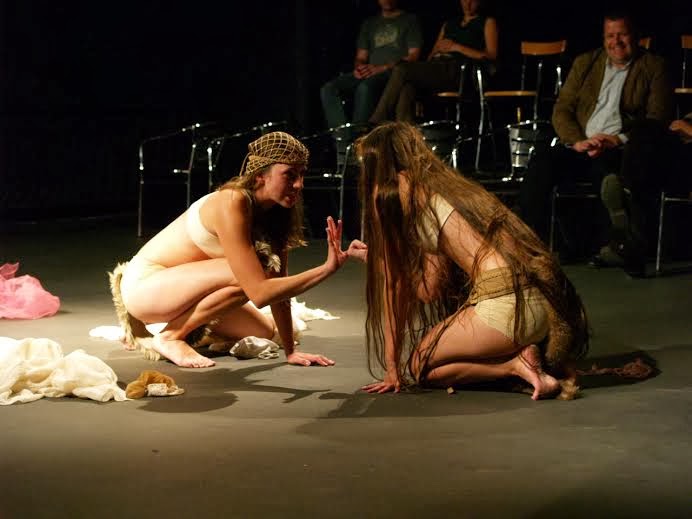
Rock Café, almost 8pm and there was a line that extended all the way to the entrance door. This queue consisted of people wearing punk outfits; fishnet stockings, heavy dark eye-shadow and some were even rocking out the mohawk. “No way that these people are going to see the play!” I thought. at that moment I decided to cut the line and ask the guy at the ticket stall about that. “No, it’s for the punk concert happening downstairs. You’re going for the play, Right?” It felt victorious to hold the entrance ticket, so did sitting down next to a few other Anglophone Studies people in the theatre room who also came to see our fellow student Magdaléna Hniličková perform.

I was told beforehand that the play will be 1) short, 2) performed mainly in underwear and yet 3), not at all erotic in the Nabokov novel sense. Even with these warnings, I did not expect the performance to have such psychological depth. Through story-telling, masks and role plays, the two young female characters opened up to the audience. There were frequent shifts of emotion; at one moment, the audience was laughing almost hysterically at their wolf dance or sexy-lass dressing-up, but just as quickly silence filled the room as a story implying rape was told. This dynamism of both verbal and physical form in combination with light effects and occasional usage of drumbeat and xylophone music kept all senses alert and one did not feel the urge (or even thought) to look at the time.

Once the play was over and the room was in a few-second of darkness, I was in a short mental pause. As the lights went up again and applause filled the room, I came to the realization that “Lolitas on the Road” discusses matters that are more relevant and understandable to women than to men. This was due to lines such as “Why should you get dressed up for him? You should do so for yourself!” or “Life with men is hard – but without them, it’s even harder, you have no choice.” Nonetheless, I believe that both genders can benefit from seeing this performance that will take your mind off matters like exams, credits or post-Christmas weight gain, if only for 45-50 minutes.

-          Anna Hupcejová


(Image credits: Vojtěch Morava)

“Lolitas” in a paragraph

The two "Lolitas" seem to be having a tough time deciding what to wear - but there are two lost and scared souls crouching underneath the layers of innocent white cloth or provocative tulle. A thought-provoking play shows the transition from innocent playfulness to a new identity which may as yet appear unclear and disturbing. What is the play about, then? About doubts and fears, hidden behind girlish giggling? About looking for your new identity and being surprised at what you find? About being supposed to grown up and not having a clue how such things are done? You’d better see and decide for yourself. This short play may well provide you with enough food for thought for a week.


-          Denisa Šebestová

Henry V and Coriolanus: A Day with Shakespeare on the London Stage

London is a dream come true for theatre lovers. From contemporary and experimental drama, through musicals, to the classics, there is a performance for everyone, and often with a stellar actor in the lead role. As one wanders around the West End and Covent Garden, names like Ben Whishaw, David Tennant, Matthew Macfadyen, Jude Law, or Tom Hiddleston glisten on the posters decorating the fronts of the theatres. The last two gentlemen star in productions of Shakespeare's plays Henry V and Coriolanus respectively – both critically acclaimed and sold-out performances, or perhaps not quite sold-out. Sometimes getting up well before dawn and queuing for hours in the hope of snatching one of the few returned or standing tickets is just what it takes to get in, and I did. The 4:30 a. m. start was well worth the effort for having the pleasure of witnessing Jude Law lead the English to the battle of Agincourt in the afternoon, and Tom Hiddleston almost singlehandedly defeat the town of Corioles in the evening.

Henry V is one of Shakespeare's finest history plays, portraying the king of England making his claim on France. Directed by Michael Grandage at the Noel Coward Theatre, this play about leadership, warfare and patriotism – themes that resonate with the audiences to this day – is brought to life in an exciting production. A whitewashed wooden half-circle serves as a set, clearly referencing the “wooden O” of The Globe the Chorus mentions in his opening speech. Its simplicity leaves much to the imagination of the audience, while providing a space for mood-enhancing projections and allowing ingenious use of the various doors and trapdoors to portray the changing locations amid the chaos of battle. The actors appear in medieval costumes, except for the Chorus whom Grandage also assigns the role of the Boy. He is clad in contemporary clothing, wearing a Union Jack T-shirt and jeans, thus establishing perhaps a little too forcefully a link with the present. His double role, performed by the energetic Ashley Zhangazha, often highlights the contradictions of the grand patriotic speeches of the Chorus and the bloody reality of war.


Image credits: Magdalena Císlerová
Whether or not Henry's war (or any other for that matter) is just is one of the principal concerns of the play, and one that is not resolved easily. Jude Law gives a wonderfully complex portrayal of the warrior king, unafraid to highlight Henry's moments of introspection, fear, or anger alongside his authoritative royal conduct. He excels at the rousing “Once more unto the breech” and the St Crispin's Day speeches, while not shying away from Henry's darker moments, which he performs with chilling intensity, such as the threatening speech to the people of Harfleur or ordering to kill all prisoners. His wooing of Jessie Buckley's French Princess Katherine is just the cherry on top of a great performance. This marvellous scene, so often cut considerably in many performances, is incredibly witty, humorous and romantic at the same time, and Law plays it with exactly the right amount of cockiness, playfulness and affection, winning not just the sympathies of the princess in question, but of the whole theatre.

Incidentally, Tom Hiddleston stars as Henry V in The Hollow Crown series, the recent BBC's superb adaptation of four Shakespeare's history plays: Richard II, Henry IV Part 1, Henry IV Part 2, and Henry V. However, he takes on quite a different role – that of a proud Roman general who goes from hero to zero – in Josie Rourke's production of Coriolanus. Set in the early days of the Roman republic threatened by the Volscian army, Coriolanus almost singlehandedly wins the battle and returns to Rome, celebrated, to run for consul. Yet he is unwilling to overcome his pride to suck up to the plebeians, and is expelled from Rome. He joins the Volscians in order to take revenge on his own city. A play full of angry crowds and bloody battle, the tiny 250-seat Donmar Warehouse makes for an interesting choice of venue, however the play works surprisingly well in such an intimate space, which Rourke utilizes ingeniously. The staging is reduced to a brick wall sprayed with graffiti by the plebeians demanding “Grain at our own price”, complemented only a by a single ladder and a row of chairs, which together with a few fireballs are enough to convey brilliantly the battle scenes at Corioli. Graffiti is added throughout the performance, chairs are manoeuvred around as loud techno music fills the theatre, while the actors stroll around the stage in an eclectic mix of contemporary and Roman clothing, the soldiers sporting skinny jeans and Doc Martens with leather armour, gloves and swords. The refusal to confine the production to a certain period of time emphasizes the relevance of many of its issues, such as the struggle for democracy, power of manipulation, and the responsibilities of public service, to today's audiences.

The fights are ferocious, so much so that in one scene Coriolanus emerges from behind the battlements so drenched in blood he later takes a shower on stage, gasping as the water hits his wounds. It is quite an extraordinary moment, providing not only eye-candy for the female audiences, but more importantly showing the vulnerability of the flawed hero, turned into a killing machine by his monster of a mother who rejoices at each of his new scars. Hiddleston gives a breathtaking intricate performance as the Roman soldier: fierce in battle, humble after victory, scornful in his treatment of the plebeians, gentle with his wife, and thunderous upon his expulsion from Rome. When his mother, wife and son plead him to spare Rome, Hiddleston's long unmoving gaze reveals with much intensity his dilemma and emotional turmoil as he decides to exchange pride – his vice – for sympathy, knowing he is signing his death warrant by doing so. The rest of the cast deliver superb performances as well, especially Deborah Findlay as Coriolanus' overpowering mother Volumnia, and Mark Gatiss as the witty senator Menenius.

Neither Henry V nor Coriolanus are among the most popular plays of the Bard on the Czech theatre scene, but on the stages of the Noel Coward Theatre and the Donmar Warehouse they come to life with such a thrilling force in well-crafted and illuminating productions that it is clear they have much to offer. As I was leaving the Donmar Warehouse that night, the poignant image of Coriolanus' execution still fresh in my mind, I knew that the fate of the warrior king and the Roman general would stay with me to ponder long after the tube ride to my temporary London home was over.


-          Magdalena Císlerová

The Hobbit: The Second Something Is Out

When you first found out that there was going to be three films out of a 300-page book, you may have been surprised and scowling, indeed. Nevertheless, once Peter Jackson did not disappoint me with The Lord of the Rings, I decided to go to the movie theater without any prejudices. The first installment of the trilogy, The Hobbit: The Unexpected Journey, rather pleased me since I do not seek much violence and exaggerated actions in movies. To make my points in this review I should also note that I have gotten ever so tired of hearing ‘the book is better than the film’ in reference to every movie that has been made out of a book (how can we even compare a film to a book?), so my review shall regard the film version, not the book.

The Hobbit: The Desolation of Smaug has, compared to the prior part, very exaggerated action scenes, so exaggerated that they make us think whether Jackson really meant them seriously, alas, I reckon he did. The dwarfs are ridiculously immortal so that when Smaug hunts after them for a half an hour in the Lonely Mountain, he cannot kill them, even though he has got fire coming out of his mouth at will – I do not understand how he could conquer Erebor in the first place, lazy dragon. Secondly, there is this rather peculiar dwarf-elvish romance which is obviously a very unlikely thing to happen (well, it teaches us not to be racist; but a dwarf and an elvish lass, seriously?), so why did it happen? I sense that Peter Jackson has fallen to the stream of creating entertainment where cheap laughs, romance and exaggerated actions are essential to entertain. The romance thing quite worked in The Lord of the Rings (Arwen and Aragorn) perhaps because it was not so far-fetched. Tolkien wisely omitted involving romance in his books, I wish Jackson had as well.

The main problem is, I believe, that the movies attempt to trick us into thinking it is the LOTR all over again - but it is not! It is a different book and we do not really need to be seeing all those LOTR characters that has no say in the plot anyway because of its little story (with the exception of Legolas that actually was in the Hobbit book - even though Tolkien himself did not know his name then - , because he really comes from Mirkwood and Bilbo and his dwarfs do encounter Elves there). The same goes for dividing the 300-page book into three three-hour long films - the extended edition of The Return of the King is mind-bogglingly astonishing despite its four-hour run time. But what shall you see if you get the extended version of The Hobbit movies? Well, more walking and singing, I reckon.


Another problem is, that neither of the first two installments of The Hobbit films do not have an ending. Each of the LOTR movies had one because it was made out of three separate books but The Hobbit: There and back again is just one book, and if you divide it into three parts, you get two somethings and one ending. 

Matěj Vašíček

Conversing with Alasdair Bouch: a Prague-based English Musician

I met Alasdair at the January Alchemy and was surprised to find an interview done with him already. Though almost a year old, this interview done originally with Ffakt magazine is a great introduction to the British singer-song writer as it presents his newest album, his reasons for settling in Prague and the hardships and pleasures of a full-time musician’s life.

For how long have you been living in Prague? And how does an English musician end up in the middle of Europe? 
I arrived nearly seven years ago now, and it’s flown by.  I actually didn’t intend to stay – I originally came here for a month to learn how to teach English, and immediately fell in love with Prague.  Most people don’t believe me when I say that – of course, the beautiful women and beer might have influenced my decision to stay – but there’s something magical about this city that draws you in.  And as Kafka wrote, its claws won’t let you go!

Are there any aspects of Czech music, life or art you especially enjoy?
I wasn’t surprised to find that the Czech Republic has an extraordinarily rich cultural history; I was already aware of – and admired – many Czech writers and filmmakers before I arrived.  I even had four Mucha posters on my wall as a student in Wales!  But I was perhaps intrigued to find how closely I identified with the artists here.  Czech literature is profoundly affecting, the films witty and moving, and the art and architecture dazzling.  My favourite writer has to be Hrabal – if I were to write fiction, I would want to write like him.  He brings me to tears and laughter, often on the same page.  Seifert is a sensual and vital poet.  The directors Menzel, Svěrák, Hřebejk and Lipský are all masters of their craft.  But all these are just scratching the surface.  When I arrived here, I read every translated book in the library by a Czech author, bought any DVD I could find with English subtitles and visited all the museums.  I totally immersed myself.
Image credits: Michal Mecner
Who were the bands or musicians who made you wish to become one of them? Was “being a musician” a childhood dream, or how did you decide about your career?
When I first picked up a guitar at the age of 15 or 16, I was listening to Led Zeppelin, Pixies, Lenny Kravitz and Jane’s Addiction – as well as all the 60s folk troubadours.  My mates and I would set up our cheap amps in my parents’ garage and just shred.  We played at parties and the local church hall – unsurprisingly, Sony didn’t come calling!  Although I had been singing all my life, it was never a dream of mine to be on stage professionally.  I never thought of it as a sensible career choice – I still don’t!  Basically, it just crept up on me – I was working so hard on my music that one day I woke up and discovered that I had made a full-time career of it.

What does it mean to be a full-time singer-songwriter living in our times?
I’m glad you asked!  Excuse me if I get on my soapbox for a minute.  Being a full-time musician isn’t just a case of showing up to a gig five minutes before you’re due on stage, rocking the crowd for an hour or two, then hitting a hotel room with a couple of groupies.  That’s only part of it!  There’s hours of practice, years of honing your craft on stage, composing songs, writing lyrics, recording and mixing albums, arranging licenses and copyright, promoting your music online, uploading your songs and photos, designing posters and artwork, devising press releases, creatively blogging and emailing your fans, making videos, sourcing new venues, booking shows, long hours travelling to foreign shows, buying equipment, selling your product, balancing your finances and finally, paying your bills.  It’s amazing there’s any time for performing after all that!

On top of that, many people don’t think twice about illegally downloading your music, or giving it away to all their friends.  If your albums are self-financed, as mine are, that really jeopardises your chances of making the next CD.  Without new music every year or two, it’s hard to keep the fans engaged.  So you have to tour constantly to put bread on the table.

That said, it’s not all doom and gloom, so I’ll stop complaining now!  The Internet has given musicians many opportunities that they didn’t have a decade ago.  If you weren’t signed to a record label, it was hard to get noticed and sell albums beyond your immediate fan base, hometown or regular touring schedule.  The Internet has levelled the playing field a bit.  Now every bedroom musician and their dog can have a music website, but equally, everyone has a good shot at getting noticed.  You might not have a massive advertising budget, but if the wind is blowing in the right direction, you can still make a mark.

Do you collaborate with Czech musicians or other artists?
My current band is truly international – we are British, Czech, Slovak and American.  I am utterly blessed and honoured to be working with some of the best musicians in Central Europe.  I also use phenomenally gifted local artists and photographers for my album art.  When I have time, I occasionally help out venues looking for bands, so I check out a lot of live music.  I have met so many talented performers here, whose music I believe deserves to be heard – among them Nylon Jail, Jan Řepka, Martina Trchová, Ondřej Galuška, Žofie Kabelková… all fantastic songwriters.  I used to organise fashion markets in Prague too, because I met many incredibly original designers, but sadly I don’t have enough time for that now.  Nevertheless, it is so important to support home-grown talent.  Next time you need a present for someone, consider buying them something handmade and local.  It’ll last longer, look better, and you can bet no one else thought of the same thing!

How do you compose your songs? Are they based on your own life and experiences?
People always ask me if the words or the music come first.  The chicken or the egg.  Sometimes, I’ll have a melody running through my head, and I just find some random words to fit the tune.  Often those words end up in the final song, or even determine the subject matter.  Other times, I’ll stumble upon a great sounding phrase, and the tempo of the words will suggest a melody.  But I can’t choose when the muse will strike.  Often I’ll be walking down the street when I dream up a new song – then I have to hum it all the way home, in case I forget it before I get to my guitar!
Somewhere along the line, someone told me the maxim ‘write about what you know’.  Pretty much all of my lyrics are based on personal experience – either my relationships, philosophy, or life on the road.  The core of my song-writing has to be based in truth.  How can I expect people to identify with my lyrics, if I’m not honest with them?  Even the rare story-song I write has to come from something I have felt deep within myself.  One song on my new album, ‘Third Time Lucky’, is about a homeless man who finds life getting harder every year.  The idea for the song grew from a night I spent sleeping rough on a pavement in Dublin in the middle of winter – probably the most miserable night of my life.  I could never forget that, and the thought of spending my entire life on the streets is almost unbearable.

How would you describe your newest album? Is it different from the previous ones?
Musically, it is a little different.  My debut album ‘First Person Singular’ had a solo acoustic, alternative folk-blues sound and it featured a lot of guests playing wooden instruments!  The next, ‘Second-hand Lullabies’ was more soulful rock, with a full backing band and a more radio-friendly feel.  The new CD, ‘Third Time Lucky’ shows a slightly harder, darker side of my song-writing.  There’s still the uplifting anthems to sing along to, but it’s soaked in old-school rhythm ‘n‘ blues tears and late-night whiskey laments.  Lyrically, there are still songs about love, death, hope and heartbreak, so the old fans won’t be disappointed!

If people want to listen to your music, what are the real and virtual spaces they should visit?
The websites which get updated the most are ReverbNation and Facebook – if you become a fan, you’ll get invited to shows and discover all sorts of exciting stuff there.  I don’t play any regular shows in Prague, but I really like Joy, and I’m sure to play there again soon. 

‘Third Time Lucky’, the new CD by Alasdair Bouch, was released on 10th May 2013. Keep an eye on MP’s Facebook page for Prague concerts information!

Prepared by Petra Johana Poncarová from Ffakt Magazine; published on the 15th of May 2013.

New Year, Same Alchemy

It was the first Monday of the month and the Alchemy family met again in the basement of the NAPA bar. Against the orange wall; prose and poetry was read, lyrics were sung and stories were told and the red lights on the floor created a Christmas-like atmosphere, though it was the 6th of January already. During these performances that –as always- lasted no more than 7 minutes, beer and wine was drank and the basement was fairly warm, despite the cold winds blowing from the river and sprinting through Charles Bridge, located just around the corner.

The evening started off with Ken Nash (founding father of Alchemy), who played a row of songs from his newest album “Human Creatures”. Performed with a poker face, the humorous lyrics of songs like “Old Folks Home”, “Laundry Day” or “Like Her” together with laughter filled the space and created a positive beginning of the evening. After him, an old American man came up and explained the story behind the text imprinted on the T-shirt stuck on the wall that said “Ken Nash is stalking me” – again, the sound of amusement echoed throughout the room.
(Image credits: Anna Hupcejová)

The evening developed spontaneously, jumping from genre to genre. David Stringbreaker read a few poems that included “Small People” (published in this issue); Stephan Delbos read a translation of a story by the Czech writer Nezval or Hans Fellmann, who recited a couple of his poems – which was quite a change, as usually he reads prose. There were more performances, but I don’t recall them so well or I didn’t find them worth mentioning (like a long, rather descriptive poem about anal sex).

The night concluded with a final roar of laughter caused by Willie Watson’s poem that compared the Prague metro to a Sparta match – with his Cheshire Cat smile and the unique themes of his song lyrics, his performance is always one to look forward to. Just like the future Alchemy readings that I would recommend anyone interested in creative writing to attend.

-          Anna Hupcejová

ALCHEMY READING AND PERFORMANCE SERIES
Prague's premier monthly English-language literary event with featured guest performers and an open mic. More at www.alchemy-prague.com and find us on www.facebook.com/alchemyprague

If you want to receive information concerning the readings, sign up to: alchemyprague@gmail.com

Questions for Hans Fellmann

I approached Hans after attending my first “Alchemy” reading in October, where he made the entire room laugh hysterically with a hilarious life story. He is usually the guy who sits at the back of the room in silence. He has a raspy voice. But once on stage, his voice loses its coarseness and becomes fluid. This tête-à-tête interview reveals more about this Boston-born, Prague-based American writer.


  • ·        On Prague and himself
How did you get to Prague in the first place?
When I was 17 years old, I got a call from my rich aunt. She was drunk and said something like “Look Hans, I wanna give you a little graduation present – a ticket to anywhere in the world.” I didn’t know if it was the alcohol talking or what but her offer still sparked something in me so that day I got on the computer and planned an enormous trip through North Africa and Europe. I left the following summer with a buddy from my hometown, but he got kinda homesick and split early. Then in Budapest I met this organic-hippie type with dreadlocks and mismatched socks. He was from Georgia and had been travelling Europe for months on end. I didn’t know where the hell I was going so I asked if I could tag along. He said, “Sure, my next stop is Czech Republic.” I hadn’t planned on visiting this country but I said “Why not?” Best choice I ever made.

What year was that?
That was back in 2000, when The Czech Republic was still opening up. There weren’t many tourists, which was really nice. It felt like we had the whole place to ourselves. Our first stop was Český Krumlov. I was blown away by its architecture and quaintness. Then we went to Prague and that really kicked me in the pants. I knew I had to come back. Over the following six years, I returned twice. Then after serving as a Peace Corps volunteer in Turkmenistan from 2006-2008 I was back in my hometown of Livermore, California. I lived with my folks there and wrote my first book. When I finished, they basically told me it was time to get a job and hit the road. Luckily my father had a connection at a language school here in Prague. I set up an interview with the school director, bought a plane ticket and took a chance.

Has your impression of Prague changed over the years? Is it a good place to live and write in?
Prague is a fantastic place to live and write in, but it’s a terrible place to save money if you’re working as a teacher. My pay-checks up and vanish by the end of each month. I save almost no money and the little money I do save I invariably spend on booze and travel (laughs). But yes, my impression has changed. When I first came here I only knew the tourist trail from Old Town Square up to Prague Castle. But now that I’ve lived here for a while, I realize that the place that captures me the most is my neighbourhood, Žižkov. I love it. It’s the gritty underbelly of Prague and all the coolest bits of history are there. Not to mention, it’s been the home of a lot of great writers.

Like who?
The Nobel Prize winning Czech writer Jaroslav Seifert lived right down the street from me. Jaroslav Hašek, author of “The Good Soldier Švejk.” Plus, Franz Kafka is buried there. And even though he’s not considered “Czech” because of his German-Jewish roots, he is still part of the literary landscape of the neighborhood. Anyways, to answer your question, my impressions have changed. I realize now that Prague is much more than just Old Town Square and the castle.

So what’s your favourite part of the city?
Žižkov, hands down. I know this because about a week ago I went to go look at place in Holešovice and on the tram ride there I was already missing Žižkov (laughs).

Really?
Yeah, it’s an awesome place. The tower, the crawling babies, the Roma, the Russians, the working class Czechs, the grimy pubs, the drugs, the bums, the barking dogs, the faeces/dung shit everywhere... That’s my spot, baby!
Image credits: Anna Hupcejová
How’s your level of Czech?
I didn’t know any Czech when I came out here about 3 years ago. But after a month or two, I threw myself into it. I loved the fact that it has one of the rarest sounds in the world, the “ř” sound. I mean, most people fiddle with Romance languages like French or Italian, ‘cuz they’re “pretty.” But I liked Czech ‘cuz it’s f*****g hard. I always compare it to a sea urchin – dark and spiny on the outside, but once you crack its shell, it’s all soft and gooey in there. Anyways, I studied Czech hard ‘cuz I didn’t wanna live in a bubble. Out here, the signs, newspapers, movies, billboards, people’s conversations, they’re all in Czech and if you don’t know it, you’re letting this whole place slip away from you. I’m not saying I speak Czech perfectly or anything, I still make mistakes. But I’m fluent enough to feel like I actually live here and that makes all the difference. 

How would you get into the English literary circles in Prague?
In 2011, my ex-girlfriend (she’s Czech) brought me to Microfest, which is a literary festival held every year here in May. I met Louis Armand, Ken Nash and others of the Prague writing scene there and dug most of what they read. I went again in 2012 and 2013 and met other writers. The scene was small but I liked that because it meant that with enough hard work I might actually have a real chance of making an impression on someone.

How did you find out about Alchemy?
Through Ken Nash – its founder. He told me that if I wanted at shot at Microfest, I had to prove myself at Alchemy first. I’ve read there four times now and had some success. It’s a great opportunity to read your stuff in front an audience and I’m glad to be a part of it.

So your future goal is to be featured at Microfest?
That’s definitely in my sights. But before I do, I wanna make sure I’m ready. This means really honing my prose and selecting only the best to be presented.

You were born in Boston, but grew up in a small town in California. Your Dad is of German descent and your mother of Mexican. You speak Spanish and English fluently ...
Yup. From the ages of 1 to 4 I lived mainly with my Mexican grandparents. I was the first male in the family which is a big thing in Latino culture. My grandfather pretty much treated me like his own son and taught me Mexican pride and to speak Spanish. I think my dad, who was away working during this time, knew that his smaller German-American family might not have much cultural influence on me so that’s why he gave me such a German-sounding name. This kinda split my identity though and when I started school I had a helluva time. For the Anglo kids I was too dark-skinned with a funny name they couldn’t pronounce, and for the Latino kids I was too light-skinned with an absolutely hilarious name they couldn’t pronounce. I didn’t really fit in anywhere. Maybe that’s one of the reasons I enjoy travelling and finding out what makes other cultures tick.


  • ·    On writing
What was the first thing you ever wrote?
When I was a kid there was this sewage treatment plant down the road from our house. Everybody hated the place with a passion because it stunk so bad. I remember there was a sign that hung above the river of untreated water there out front. So one day when I was about five and a half, I got the urge to write a story about an evil little gun that came to life and shot that warning sign down so that passersby couldn’t see the river of s**t in front of them. Naturally, they all fell in (laughs, shaking his head from the memory before continuing). I illustrated the whole thing and showed it proudly to my mother. I can still remember the horrified look on her face!

What do you enjoy writing the most?
That’s a tough one. It depends what inspires me at that moment. I enjoy writing creative non-fiction and poetry. I also enjoy writing rap, which I’ve been doing since my teens.

Would you like to perform some of your rap?
I’m working up the courage to. I haven’t written any rap for a while so...

Well, we do have 7 minutes at Alchemy!
We do, indeed. And I’ll definitely perform a rap song there before I leave Prague.

What are your main sources of inspiration (books, music, real life events)?
There are a number of sources. At the front of these, I’d say, is my mixed cultural background. Second, would have to be travel. Then there’s of course women and alcohol (smirks). Most recently, I realized that a good source of inspiration that doesn’t involve hurting my wallet, heart, or liver is riding the public transportation here.

Public transportation?
Yeah, the tram especially. You get all these people crammed into one tiny space and you see them at their best and their worst. You see people fighting, crying, breaking up, talking on phones to loved ones, mothers nursing their kids... all that for 3 to 4 hours a day. It’s an endless source of material.

So whenever you can, you take the tram?
Yup. That’s something my ex-girlfriend taught me. Before I always took the metro because it’s quicker but then she said. “You’re so American, take the tram! It’s slower but you really see the city and the people.” I resisted her for a while. Turns out, she was kinda right.

Do you ever experience writer’s block? How do you tackle it?
Yes, it’s a nerve-wracking experience. I’ve found that it has three sources: one, you run out of material to write about, so you gotta get up and move and do something new. Two, you lose your verve or “burn out” as they say, which may be totally incurable. And three, you try to write about a topic that’s especially painful so your mind puts some kind of subconscious block on it. For me, this was my time serving as a volunteer in Turkmenistan. I saw a lot of horrible things there, many of which I’m still dealing with.

So how did you tackle it?
Very, very slowly and carefully. When I started writing my book about Turkmenistan last year I made the deadly mistake of diving head first into all my journals, videos, and letters from that time. This caused me a great deal of anxiety and I couldn’t figure out why. When I finally realized it was because I was reliving all those painful moments simultaneously, I took a step back and reassessed. After a three-week break, I approached it slowly, writing careful outlines, going through my journals and videos at a delicate pace, etc... The words eventually came to me. Now I’ve already written a quarter of my book.

Is writing your profession or just a hobby?
Writing is definitely not a hobby. I may not get paid for it but everything I do (i.e. teach, live abroad, travel, etc.) is so I can have the money and material I need to support myself and write. I chose teaching English as a day job because it puts bread on the table and I can do it anywhere in the world. Plus, at the end of the day I have enough time and energy left to write.

So what’s your university degree in? English? Creative writing?
International studies. My area of focus was Middle Eastern politics. My languages of focus were Arabic and Farsi. Because of all this my folks wanted me to be something practical like a diplomat or an ambassador. When I told them I wanted to write, they said “Be a journalist.” When I finished my service in Turkmenistan, I got offers from Chevron and the FBI to work as an interpreter. But I said “The hell with all that, I wanna write.” This was tough on my folks at first. We have a very academic family and my choice not to pursue that route was hard for them to understand. When they saw I was serious though, they really got on board. Now they’re half the reason I’ve gotten as far as I have.
 
So have you published a novel?
No, not yet. I’m working on getting my first novel published.

What’s it about?
Well, I grew up in a small town with a group of guys who like me were of mixed background. We got into all sorts of crazy stuff shit together so to conceal our conversations about these things we developed our own way of speaking. We invented words, gestures, intonations; we also borrowed heavily from Spanish and African-American English. When we didn’t have a word for something we used a special multi-layered form of sarcasm we invented. This way we could thoroughly confuse the listener, even when using normal English words. We called this language “R.O.A.S.T” (short for, “Result of a Small Town”). One of my buddies even wrote a college term paper on it...
Eventually, I got these guys interested in travelling. We did Latin America in 2003 and 2004. Then in 2006 we did our biggest – an 85-day monster all around the world. My first book is a fictionalized account of this trip. And it should come as no surprise that Prague is one of its highlights.

So you’re working on a second book now?
Yeah, like I said, I’m writing my second book, which is a fictionalized account of my volunteer service in Turkmenistan. I’m also working on two compilations of poetry, one of which is about Prague.


  • ·     Last questions on literature and the future
Do you have a favourite line from a poem or novel?
Yeah, there is one by Henry Miller from “Tropic of Cancer.” It goes something like “I am the madman who dances with lightning in his hands.” I really like that. It struck me, no pun intended (laughs).

Have you read any books by Czech authors, in English or in Czech?
Recently, I read “Immortality” by Kundera in Czech. I really liked it. I still think about some of the questions it posed, like, “Can people achieve immortality by etching themselves indelibly in the memories of others?” I also read “The Unbearable Lightness of Being” in English. I liked it too, though I thought “Immortality” was better.

What are your plans for the future, both as a writer and an expat in Prague?
In 5 years I’d like to have a book or at least a compilation of poetry published. I’d also like to have mastered the art of capturing images and moments using as few words as possible. If I could be making a little bit of money from my writing, that would be nice. This way I wouldn’t have to teach so much! Don’t get me wrong, I like my job, but I don’t live for it like I do for my writing.

What about Prague?
I will live here for another two years. And in 5 years’ time... we’ll see, maybe I’ll meet a girl and stay for longer. I definitely want to finish writing my second book here. I’d also like to edit my first book down to a more manageable size.

How long is it now?
Well, there’s the book and the R.O.A.S.T dictionary behind it, which together take up about 400 singled-spaced computer pages. In terms of normal book pages I guess that would be about 800.

How long did it take you to write it?
10 months. It literally flew out of my fingers. Editing it is going to take a while though. I’d like to size it down to about 300 book-pages and try to publish it that way. The more detailed version will be just for my friends, to whom the book is naturally dedicated.

-          Prepared by Anna Hupcejová